Monday, October 28, 2019

Week 8 Thoughts

Let's dive into week 8 (not including Monday night):
San Francisco was the most impressive team of the week in its domination of the Panthers. The Jaguars (against the lowly Jets), Seattle (against the Falcons), New England (against Cleveland after a monsoon in the Northeast), Minnesota (against Washington) and New Orleans (against the Cardinals) all took care of business against much inferior opponents. The Eagles also thoroughly outplayed the Bills. The Rams offense was dynamite against the carcass that is the Bengals, however Cincinnati was still able to move the ball themselves with solid efficiency. Not the best look from Wade Phillips and co. The following games were as close as can be and simultaneously terrible: Chargers versus Chicago, Tampa Bay versus the Titans, and Broncos versus the Colts. Given the Colts aspirations as an AFC wild card, this showing was a bit disappointing. Here are the early down team efficiencies from this week: 
Seattle and Jacksonville really put the boots to the Jets and Falcons respectively. The Patriots and Browns clunker does not show out here, but a lot of that can be contributed to the aforementioned terrible weather. The Lions and Giants game looks a lot closer upon further inspection. Both teams struggled offensively on early downs and played better on third downs. Given the state of Giants defensive depth chart, this should not have been an extremely satisfying performance for the Lions. The Washington and Minnesota game also looks a bit closer when isolating early down performance. Given actual length of the game, once Minnesota went up early, Mike Zimmer really took his foot off the gas and Bill Callahan did nothing to take advantage. Despite trailing the entire game (bad weather aside), Washington only attempted 21 passes. 

Finally here are the scripted play offensive performances: 
Given Cleveland's early turnovers, it is not surprising in the slightest to see them at the bottom. But losing more than a point per play to open up the game? Amazing work. The Jets actually looked solid to start the game. Given the final differential in expected points, their start faded quickly. The Lions started out strong against the Giants, while their opponents could not reciprocate. It really seemed like that game could have been a lot closer if the Giants showed up at the start. The Chargers were dreadful on their scripted plays, almost as bad as the Browns. But they went into Chicago and actually won the game. I guess the gravity of Mitch Trubisky pulled them back into the contest. Chicago, having hemorrhaged draft picks the last two seasons, is in for a rude awakening these next couple of seasons. 

Monday, October 21, 2019

Week 7 Thoughts

Week 7 was one of, if not the, most lopsided weeks to date. Only three games (pending Monday night's tilt between the Jets and Patriots) were within one score. Despite the relative sleepiness, let's take a look at the slate that was:

Remember, negative defensive EPA is good, thus you want to see your team in the bottom right corner of this chart. The best performances of the week were turned in by the Cowboys on Sunday night, the Saints at Soldier Field, and the Chiefs against the Broncos, despite missing Pat Mahomes for the entire second half. Consequently, we see the Bears, Broncos and Eagles at the top left of the chart. The contest in Chicago was marked by the return of the often-criticized Mitchell Trubisky and he did not disappoint. The Bears put up the second worst offensive mark of the week. There is going to be a lot of heat on Doug Pederson and company as they travel to Buffalo. In a prime-time game they laid an absolute egg in Jerry World, not known to be one of the more intimidating environments for opposing clubs. Take a look at the Eagles play-calling tendencies:

Despite getting speed-bagged the entire night, they ran the ball at the second highest rate for the entire week! Only Bill Callahan bested them (Case Keenum threw 12 passes the entire game despite trailing for much of the second half. As controversial as this may seem, I am confidant in claiming this franchise is a mess). Matt Nagy was not looking to ease Trubisky back into the game at all, the Bears threw the ball at the highest rate in the league in week 7, which was a bit surprising even when you consider the game scripts. Aaron Rodgers and the Packers were humming in their game against the Raiders. They were extremely aggressive throwing the ball trying to expose a rather porous Raiders pass defense. The Lions and Vikings participated what turned out to be the most prolific shootout of the week. For the third straight week, Kirk Cousins turned in one of the most impressive performances in the entire league. The Vikings were winning for much of the game, but given the play of Cousins and Diggs the last couple of weeks, you would like to see them be even more aggressive attacking teams down the field, for they had the 8th lowest pass rate of the week. The Dolphins looked only bad yesterday with the help of Josh Allen and the Bills offense. 

I also looked at how teams performed on early downs in week 7, to try to tease out some of the noise associated with third down play:

Not too much more to glean from here. Looking at the overall play, one might be surprised by the fact that the Jaguars were able to pull out that game against the Bengals. However, when you isolate early downs, we can see that there was actually a large disparity in the quality of play. If the Bengals were not so effective on third downs, this game would have been a rout. A similar phenomenon can be observed when looking at the Falcons game against the Rams. The Rams routed the Falcons and the Falcons were still more effective than they should have been in the non-garbage time portion of the game due to third down performance. I do not mean to shock anyone too much, but I think Dan Quinn's seat might be getting a bit toasty. The Raiders were also were buoyed on third down. The Packers were dominant but the Raiders were an unsustainable 7 for 11 on third down. Finally, I noted that the Dolphins, instead of looking like an atrocity, were merely bad against the Bills. But when filtering out third downs, the gap between the two teams was substantial. The Bills offense was moving the ball with ease on early downs, but converted just 3 of 10 third downs against this awful Dolphins defense.

Wednesday, October 16, 2019

Week 6 Thoughts

Week 6 was filled with what some may call defensive battles, but others would call offensive ineptitude. Either way, let's take a look at the performances across the league. First, scripted plays:
 
The Rams really looked to establish the run early, rushing on 10 of their first 15 plays. How did that work out for them (narrator: they lost)? Considering the Steelers are starting a quarterback whose last meaningful action was at the FCS level, it is no surprise to see them slot in with the second most runs on their scripted plays (note that the Rams ran the ball more to start their game against San Francisco than a team who is on their 3rd quarterback). The Giants and Patriots Thursday game started as a rock fight and continued to be a rock fight. The Chiefs stayed the course and threw the ball on 13 of their first 15 plays with good success which helped them get out to a quick two possession lead. For those paying attention, this did not last. The Cowboys offense had a tough start against a solid Jets defense. They could not really get things going until late in the second half in that loss. Speaking of the Jets, they were much more aggressive throwing the ball to start the game than they had been prior to this week with Sam Darnold back in the lineup. It looks like they will be much more competent now that they have their starting signal-caller back. The Lions got off to a blistering start against Green Bay on Monday night. Yet they could not hold on to the lead due to some questionable hands to the face penalties on Trey Flowers and some questionable decision-making by Matt Patricia. The Lions kicked 5 field goals from the Packers 8, 4, 23, 33, and 35 yard line with 7, 4, 8, 5, and 2 yards to go respectively. This is a perfect example of how conservative play calling can contribute to a losing effort. The Browns continued their enigmatic play this week, starting the game like they were shot out of a cannon against the Seahawks by getting out to a 20-6 lead by the start of the second quarter. 

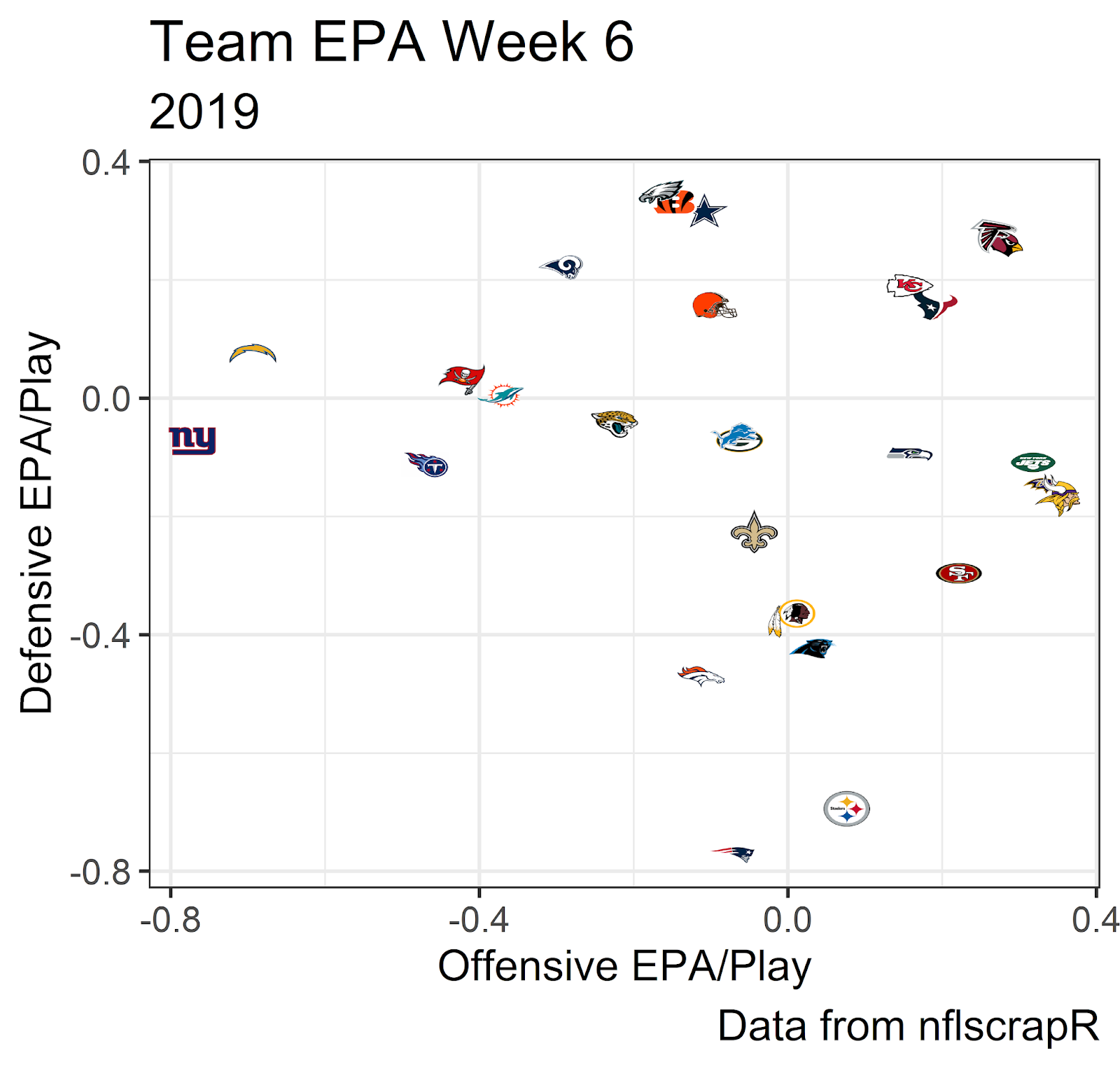
Here are the offensive and defensive results of all the week 6 games: 
Note, negative defensive EPA is good for the defense, so teams lower on the chart had better defensive performances. As I mentioned at the top, this was a week dominated by defense. The majority of the offenses averaged negative points expected points added per play, highlighted by some putrid performances by the aforementioned Giants and the Chargers against a banged up Steelers squad. The Vikings offense had another fantastic showing, this time against the Eagles and their hobbled secondary. For the second straight week, Kirk Cousins was slinging the ball around the field, this time mostly to the benefit of Stefon Diggs who had 167 yards receiving and three touchdowns. San Francisco dominated the Rams in a match-up between two Mike Shanahan disciples. The Rams, despite giving up a great deal of draft capital to trade for superstar corner Jalen Ramsey, are firmly in the cross-hairs with regards to the playoffs. They sit two games behind Seattle in the loss column and now three games behind the Niners. The match-up between the Cardinals and Falcons was an absolute shootout compared to the rest of the games this week. The Falcons came up short once again, bringing their record to a measly 1-5. Needless to say, coach Dan Quinn is firmly on the hot seat. 

Finally, here is the landscape of the league through six weeks:

After week 6, the Patriots and Niners are in a tier of their own with regards to a combination of offensive and defensive play. The Patriots offense is still one of the better units in the league, but still not quite up to its usual top-five standard. Their record has been buoyed by their defensive play. Since we know that defensive play is way less stable than offensive play week over week and season over season, I would expect some regression from this New England unit going forward. The offense is going to have to pick up some slack. The Vikings are beginning to get things rolling as the season goes along. Surprisingly, after filtering out garbage-time, the Raiders have had the second best offense by EPA per play after the Chiefs. I cannot say I saw this coming in the slightest from Jon Gruden and co. The Dolphins are still awful and making a run at having the worst point differential since the NFL-AFL merger as they continue to yo-yo between Ryan Fitzpatrick and Josh Rosen. The Falcons, Eagles, and Chargers all being in a similar spot to the lowly Cardinals should be considered a tad bit concerning. The same can be said for the Rams and Browns with regards to the Broncos. And the holy trinity of defensive-awfulness is still intact with the Dolphins, Giants, and Bengals putting up the worst performances on that side of the ball thus far. Overall, a clear bottom tier is developing between Miami, Cincinnati, both New York franchises, and Washington. 

Monday, October 14, 2019

Reflecting on the Cubs 5 Year Run

Today at The Athletic, Patrick Mooney and Sahadev Sharma took a deep dive (subscription required) into the Cubs successes and failures from 2015 through the conclusion of 2019. This led me to reflect upon this Cubs five year run and try to figure out if, on the whole, it should be considered a success. They famously broke the franchise's 112 year World Series drought; yet, this Cubs team has seemed to leave baseball fans (especially Cubs fans) wanting more. When they took the league by storm in 2015 to the tune of 97 wins (a meteoric 24 win increase from the previous season), the baseball community was not asking if this group would win a World Series but when. After the 2016 season, we spent all off-season dreaming about how many World Series this group could claim over the next five years.

Of course, this Cubs group has yet to win another championship. Joe Maddon has not had his contract renewed. Trade rumors have been swarming around the likes of Kris Bryant and Kyle Schwarber following reports of the Ricketts wanting to cut payroll. How do the Cubs pivot after this lost season? How much longer does Theo Epstein have to turn this ship around? These are the existential questions being asked in and around Wrigleyville after this season's second half collapse.

However, I would argue these questions are not totally fair. This Cubs core of Rizzo, Bryant, Baez, and Lester has led the Cubs to post one of the best five year runs in the National League since the inception of the wild card in 1994. The Cubs were swept in the NLCS in 2015 at the hands of the Mets, won the World Series in 2016, lost the NLCS in 5 games to the Dodgers, lost in the wild card game to the Rockies in 2018, and missed the playoffs this year. Those regular seasons, in order, consisted of 97 wins (as I mentioned above), 103 wins, 92 wins, 95 wins, and just 84 wins this past season. Just looking at the playoff and regular season results, this does not scream completely dominant stretch of baseball.

Looking at wins and losses can be misleading. Team strength is dictated by how much you outscore the other team by. For example, take the 2013 Orioles. They won 93 games and reached the playoffs but only outscored their opponents by 7 runs over the 162 game season (or .043 runs per game). The 93 wins came from going 29-9 in one run games which, for the purpose of determining team strength, is relatively meaningless. I would argue this Baltimore group was more average than playoff-caliber. Obviously looking at raw run differential fails to account for run expectancy and hit clustering luck but we do not have team clustering data readily available going back through the channels of baseball history. So run differential is the best tool we have on hand to evaluate team strength throughout baseball history.

I wanted to see how this stretch of Cubs baseball compared to all other five year stretches by every National League from 1994 through this season (I chose 1994 because that was the start of the modern playoff structure). The following plot shows the distribution of 5 year run differentials:


The red line represents the Cubs run differential from 2015 through 2019, which was 662 runs. This was one of the top figures over any five year stretch for any National League club. The following scatter plot highlights the only clubs who outscored their opponents more than the Cubs during this most recent 5 year window:


The only groups that outperformed the 2015-2019 Cubs was every five year stretch from the Braves starting in 1994 through the time period starting in 1998 (with teams headlined by the vaunted trio of Maddux, Glavine, and Smoltz), the 2001-2005 Cardinals, and the 2015-2019 Dodgers. The 2000-2004 Cardinals and 2014-2018 Dodgers were just behind this Cubs group. These teams, not including the Cubs combined for six NL pennants, 1 World Series win, and 13 NLCS appearances. Given the quality of these teams, one might expect these teams to have collected more than just two World Series trophies (three if you include the Cubs).

This discrepancy in results versus expectations can be attributed to the randomness associated with playoffs. A five or seven game series is not enough games to determine the better team. The Cubs have put together one of the most dominant stretches of regular season baseball in the last five years. Even this year, a disappointing campaign, the Cubs outscored opponents by 97 runs. They have just as much hardware to show for as any of the other great National League teams in the wild card era. All of the hand-wringing over the Cubs their future is overblown. They largely return the same group of players. Whoever replaces Joe Maddon is going to have a great group of players on hand. Despite the 84 wins, the Cubs should still be the National League Central favorites going into next year. Save your Cubs obituaries for the future.

data via Baseball Reference

This post appeared on the FanGraphs community form

Friday, October 11, 2019

Thoughts on Clayton Kershaw's Playoff Struggles

Anyone who even tangentially follows baseball is aware of the narrative that Clayton Kershaw struggles in the playoffs. Over the course of his career, Kershaw has produced a 4.43 ERA in 158.1 playoff innings, a far cry from a 2.44 ERA in 2274.2 innings pitched in the regular season. This dichotomy has turned baseball fans all across the country into armchair psychologists. Many say he cannot handle the pressure associated with the crucible that is October baseball. I, for one, am not a psychologist by education and therefore have been skeptical of such a narrative. I think there is a misconception regarding player ability, probability, and distribution of outcomes. We often expect a player to always perform at a certain level based on what they have done in the past. In reality, a player's true talent, which we can never exactly suss out but instead estimate based on past performances and aging curves, represents the player's 50th percentile outcome in a given start, string of starts, or seasons. Player performance should be looked at as a distribution of outcomes; sometimes a player performs at his 5th percentile outcome or sometimes he blows us away and performs at his 95th percentile outcome. All else being equal, however, we expect the bulk of his work to be somewhere in between 10 percent worse and 10 percent better than his elusive true talent. To suggest that there are not outside forces that can affect how a player performs would be foolhardy, but I also find it difficult to speculate on those outside forces because we, as fans, cannot possibly know which directions those forces pull along a player's distribution of outcomes.

That brings me to Kershaw. Kershaw is the best pitcher of his generation; he has, over the course of his career, produced an ERA 57% percent better than league average (adjusted for park and league context) according to Baseball Reference. In his most dominant stretch, from 2013-2017, he produced an adjusted ERA that was 92% better than league average. This is one of the most dominant stretches of pitching in baseball history. So why has his postseason performance been so disappointing? Well first, let me stress, given his regular season performance, his postseason outcome has a been a bit disappointing. In a vacuum, a 4.43 ERA is not something to sneeze at. It certainty is not great, but definitely not terrible. What stands out is the ramifications of some of his playoff blunders, chronicles by Ben Clemens over at FanGraphs this morning.  2013 against the Cardinals and 2016 against the Cubs stand out in particular. We fail to realize that he seems to have disappointed so often because he has pitched in so many meaningful games. It should not be forgotten how many great teams he has led to October. Still, we are left wanting more.

On Wednesday Kershaw, with the Dodgers up 3-1, gave up two homeruns on consecutive pitches that proved to be fatal to the Dodgers season. Granted, he was put in the unusual position, for him, of coming to pitch in relief, despite the fact that Dave Roberts had Pedro Baez, potent against right-handers, to pitch against Rendon and Adam Kolarek, potent against lefties, to pitch to Juan Soto. Nevertheless, in 2019, he gave up three runs in an inning on three separate occasions: a start on June 24th, a start on June 29th, and a start on August 31st. He threw a shade over 180 innings the entire year. Here is his distribution of runs allowed in an inning this season:


What can we take from this? Was he just unlucky? Let's round his innings total count up to 181 innings, which means he gave up 3 runs in just 1.66% of his innings. Or is there something more there? If he has been so potent in the regular season, maybe these blow-ups in the playoffs have something more behind them. I guess what I am saying is, after watching Kershaw for all these years,  I do not know. Maybe he cannot overcome the anxieties associated with pitching in October. Or maybe one of the brightest stars this sport has ever was just unlucky on the some of the sport's biggest stages. All I know is, as a baseball fan, I wish we did not have to wonder.

Monday, October 7, 2019

Week 5 Thoughts

There were a few surprise performances this week. The Packers big win over Dallas, the Colts outright win in Kansas City, the Broncos taking care of business against the Chargers, the Texans demolition of the Falcons, the Raiders hard-fought victory against Chicago, and the Patriots blowing out Washington (I may be kidding about one of these). With that being said I wanted to look at how all of the games went (besides the Monday night game tonight with Cleveland and the Niners) when filtering out garbage time and looking at specific splits. So, I scrapped together some visuals that will help give us some insight into how these teams played: 


Here is a visual of how each team's offense performed in all situations this past week. The Broncos effectiveness is notable given the public's opinion on Joe Flacco and the massive fall from grace of the Chargers defense following a string of injuries. Maybe, just maybe, defensive performance is subject to large amount of variance year over year and week over week, and we should stop touting great defenses as consistent difference making units. The Jets only threw the ball about 50% of the time in their blowout at the hands of the Eagles. This was essentially a bye week for Philly. The Cowboys, after a tough game against the Saints, had another bad offensive showcase against the Packers. The Chiefs did not play up to their usual standard and with respect to EPA per play, were about even with the Colts in their game on Sunday night. Also, nothing seems to jump-start an offense like a contest with the Giants. 


The ineptitude of the Chargers on early downs was impressive against a Denver defensive unit which has had a slow start to the season. The Eagles early down performance was a bit troubling, even worse than their opponent, the Jets. The Eagles were buoyed by a couple of defensive touchdowns that helped them build a massive lead. This was definitely not a great performance from Wentz and co. Given the construction of the Panthers and Jaguars' rosters, the degree to which this game was a shootout was surprising to say the least. We see a much bigger disparity in offensive performance between the Chiefs and Colts when looking at early downs. 

If the Chiefs were not so efficient on third down, the game against the Colts would have yielded a much worse result. This was the worse performance of the Mahomes era. The Jets and Cowboys lost more than two expected points per play on third down. Given the turnovers by the Jets and the margin in the Cowboys Packers game, the fact that these offenses performed so dreadfully on third down makes sense. In all situations, the Vikings really carved up the Giants, which hopefully will, for Vikings fans' sake, springboard the offense back into competency. Given the Giants depth chart, however, defensive mishaps will probably continue to be a theme throughout the year. 


Here is a plot of the scripted plays for each team (for reference, see my first post on scripted plays). The Chiefs, as they are wont to do, threw that ball a ton to start the game. What is more surprising is the Patriots, despite being 16.5 point favorites were also very pass happy to start. The Bengals were by far the most run-heavy team on their scripted plays. Given they handed the Cardinals their first win of the season, all we should be expecting from Cincinnati for the rest of the season is a top-three pick. After their opening game against Seattle, many (including myself) thought this Bengals offense could be a middle of the pack unit and would keep the team from being truly terrible. This take did age particularly well. Green Bay continues to signal they want to throw the ball a lot in neutral game scripts. The Colts and Broncos show out strong here despite their reliance on the run. And given the final score of the game, the Giants also started off their game well. Unfortunately for Daniel Jones and the rest of the Giants organization, this success was fleeting. 

Finally, I thought it would be useful to show the landscape of the league through 5 weeks on offense and defense. While only 4 or 5 games in, I am sure many are interested in how the league is beginning to sort itself out (note, on defense negative EPA is good):

Mostly unsurprising results here. Washington, the Jets, Miami, and Cincinnati are in a tier of their own. The Chiefs and Patriots are dominant. The degree to which the Niners have succeeded thus far has been very impressive. And the Raiders offense, after a horrendous season last year, is actually showing some life, putting up the second most EPA per play in the entire league (when filtering out garbage time) behind their division rival. Kudos to Gruden and co. on a successful offensive start to the season after their win against the Bears. While I still do not think this team has a playoff caliber roster, given the relative mediocrity of the AFC (excluding Kansas City and New England), I would not be shocked to see Oakland play meaningful games at the end of the season. 


Sunday, October 6, 2019

Reflecting on the First Couple of Games of the Rangers Season

With the first couple of games in the books, the Rangers find themselves with four points in hand a mighty plus 5 goal differential (I kid of course). Going into the season, any rational Rangers fan was expecting the following threads to play out throughout the year: the team would be more competitive but not playoff caliber (i.e. about an 85 point team), the top two lines would provide some firepower, the team would have no depth, and despite the addition of Jacob Trouba, the defense would be a train wreck. While our preseason expectations for the team should not change a bit after two games, I thought it would be interesting to look at how the team and certain players have fared thus far.

The Rangers overall goal differential has been buoyed by a hot start for the powerplay. At five on five, the team has sported a 55.56% goal differential, which over the course of an entire season would make them one of the most potent even strength teams in the league. However, in these same minutes they have produced a 36.55% xGF per Natural Stat Trick (xGF is expected goals for. Expected goals are calculated based on the location of the shot, the time between events, and the previous event type). This is a dreadful figure that no team would produce over the course of a full season. That being said, it is fair to be a bit skeptical of the team's start to the season. It cannot expect to be on the playoff bubble the entire season if they continue to get speed-bagged at 5v5.  Note that the first two contests were against Winnipeg, a team that has been pegged for a drop-off after an exodus of talent, and Ottawa, a team that is making no attempt to ice a competitive roster. Most of the team's even strength struggles came in its opening night game against the Jets, who we should expect to be a good deal better than the Rangers. Also, one last note, for a team with one of the youngest rosters in the league, the Rangers have yet to record a chance off the rush.

The driver of the teams success has been the powerplay led by the aforementioned Trouba, Mika Zibanejad, newcomer Artemi Panarin, Chris Kreider, and Pavel Buchnevich. The powerplay has produced 3 goals in just eight and a half minutes of ice time. Even better, they have put up 10.75 xG per 60 minutes, the third best mark in the league. This is unsustainable, but for the first time in many years, Rangers fans could be in for a top half of the league unit with all-world play-maker Artemi Panarin feeding Zibanejad and co.

Looking at 5v5 play on the player level, the first line of Panarin, Zibanejad, and Buchnevich has been the only line performing even with some level of mediocrity. The trio has put up 41.82% shot share with a 44.85 xGF% mark. Let me be clear, these are not impressive figures in the slightest. However, without any of these players on the ice, the team has produced a measly 30.53% xG share. Offense has not been the top line's problem, looking at their shot chart thus far, they have individually generated some high danger chances:

Buchnevich has yet to record a shot at 5v5, but Zibanejad has already had quite a few chances right  around the net. The unit needs to clean up play in the defensive zone, but given half of this sample has come against the potent offense of the Jets, there is absolutely not reason to panic (and that is without considering we are looking at just two games).

All of these figures will regress as the team plays more games, but concerns over the team's depth should not subside. The second line, headlined by the second overall pick Kaapo Kakko, has been abysmal. The line, which also includes Kreider and Ryan Strome, has a putrid 19.04 xGF% through two games. Many Rangers fans going into the year have concerns about the organization's infatuation with Strome after forgoing a cheap buyout of his contract. The line is clearly not as dreadful as the results would indicate thus far, but the fears regarding the decision to play Strome in the top-six have not been assuaged. Looking at the one ice expected goals for figures for the team highlights the second line's horrid start to the season:

Interestingly enough, Lias Andersson has had the team's best on ice results to start the year despite playing the fewest minutes at 5v5. Granted, he has gotten 50% offensive zone starts, so Quinn is giving him some of the easiest minutes on the team. However, considering the second line is off to a horrid start and the number-one goal for the season is furthering the development of the young core, I think it would be worth it to give Andersson some run with Kreider and Kakko. If Quinn really does not trust Andersson to play in the top six, at least try Namestnikov as the pivot between Kreider and Kakko. Namestnikov has had success in the past playing with superstars Steven Stamkos and Nikita Kucherov. He by no means drove that line when the three were played together in Tampa Bay, but there is some evidence that he can thrive playing with high-end talent.

The defense was not expected to be impressive and nothing in the first two games should change that. Most of the group is hovering around 45% in 5v5 shot share, with the exceptions of Adam Fox (50% exactly) and Marc Staal (who looks like he is skating in mud, is at 38.81%).

Overall, I would say, despite the four points, the Rangers have not looked great to start the year. The team's defense at even strength has been extremely underwhelming and besides the play of the top line, the offense has not been much better. However, the powerplay looks to be improved with the additions of Trouba and Panarin. I do stress how little two games means when evaluating a team. No one should be jumping to any conclusions. There are still 80 games left to be played. We will see if the Rangers will start to look more competent at 5v5. No matter how good the powerplay can be (and I am skeptical they can be more than a good unit given the talent on hand), the team needs to pick up its play at even strength.

Data via Natural Stat Trick and Moneypuck.com